Tuesday, September 30, 2008

Competitive Advantage - Reduce The Gap Between Thinking & Doing

Employing Marketing's Version Of the "No-Huddle" Offense

By David Miranda

Enabled by technology, the pace of the marketplace has increased at warp speed and there is no "slo mo" or "pause" button on life's "remote". If the classic tale of the hare and the tortoise were written today, the technology-enabled "hare" would win. All things being equal, in today's marketplace, the advantage goes to the smarter and the quicker.

Competitive advantage, therefore, lies in reducing the gaps between thinking and doing - between planning and execution; between wanting and getting; between feedback and response.

Today's marketplace is a 24 X 7 global competition with no time outs. Competitors are pursuing your customers as we speak with new products and services employing new marketing channels and campaigns. In a world where preference is perishable, competitive challenges must be immediately countered and re-countered as necessary.

The best position to be in is the smartest and the fastest keeping your competitors off kilter. It's marketing version of the "no huddle" offense, i.e not giving your competition time to appropriately respond, as well as, impressing your client and customers on your responsiveness.

This approach demands reducing the gap between the thinking (what do we need to do to succeed considering the circumstances at hand) and the doing (flawlessly executing the plan).

Reducing "gaps" creates competitive advantage, so get on with it.

Sunday, September 28, 2008

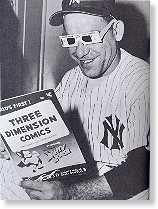
"The Future Ain't What It Used To Be" - Yogi Berra

Marketing Insights Inspired By the Baseball Hall-of-Famer


Known for his famous "Yogi-isms", Yogi Berra, Hall Of Fame catcher for the New York Yankees should be teaching marketing at Northwestern. Even experienced marketers could learn a thing from "The Yog". Take, for example, the Yogi-isms "You can observe a lot by just watching" and "Nobody goes to that place anymore. They're too busy."

Today marketers are sometimes confused and befuddled by the state of marketing today - the traditional methods are not working as well as they used to and the new stuff is coming at them from all angles. What is a marketer to do? Well, as Yogi puts it, "How 'bout just watching?" Take a moment to have a good look around. Consumers are TIVOing, spam and ad blocking, do-not-call list enrolling, podcasting, downloading, MySpacing, YouTubing and are addicted to mobile whether it be their cell phone, Blackberry, or PDA. This should tell you something.

Now take a good look at your marketing plan. Does it reflect what you are observing or does it reflect the old status quo? Has your brand extended to new channels such as cellphones, social networking sites, blogs, or user-generated content sites such as YouTube?

And what about customer service at the retail level, web site, email, or over the telephone? Yogi said, "Nobody goes to that place anymore. They're too busy." Are customers being serviced in a prompt, courteous, and efficient manner or are they forced to wait in line, navigate a challenging web site, wait unduly for email responses, or put on hold when they call. In today's customer ADD environment, it would be smart business to recognize that impatient customers are vulnerable to competitive offerings.

Yogi puts it this way. "The future is not what is used to be."

Neuromarketing - Marketing Science Or Snake Oil?


The Lure Of The "Persuasion Rosetta Stone"

By David Miranda

For those of you that missed it, I highly recommend viewing the PBS Frontline documentary, The Persuaders, originally broadcast in 2004. The compelling and comprehensive report takes us behind the curtain of the relentless pursuit of persuasion - of consumers and citizens alike.

From market research gurus, to advertising agencies, to the brands themselves, the documentary explores the quest to discover and exploit the "code" that persuades us to buy a specific brand or vote for (or against) a specific candidate or issue. It introduces us to something called "neuomarketing" - part psychology, part anthropology, part multiple regression. part etymology.

As the marketing landscape continues to dramatically morph, marketers are desperate to find the secret formula that enables their brand to "cut through the clutter" of hyper-choice. Consumers have become desensitized to marketing "er" claims as in, "brighter", "better", "cheaper", "faster", since these are quickly "me-tooed" by competitors.

Successful brands have created a "cult-like" emotional connection with their consumers as with Starbucks, Apple, Volkswagen, and Nike, for example. The question is why.

Those proponents of neuromarketing suggests that it is the result of some "reptilian response" meaning these brands have been successful in understanding and satisfying some basic Maslow-type needs in their lives. In other words, people prefer Starbucks for more than the coffee or prefer Nike more than the just the sportswear.

Is this snake oil promoted by marketing consultants or is it marketing science? I suggest that it is some of both.

Make up your own mind.

Saturday, September 27, 2008

Small Business - Do-It-Yourself Marketing Doesn't Mean "Do-It-By-Yourself" Marketing

Busting Common Myths, Mistakes, and Misunderstandings On DIY Marketing

By David Miranda

About 9 of every 10 small businesses I encounter seeking marketing advice do so because they are not achieving the business results they anticipated. Typical quandries include:

  • "We're not generating enough leads."

  • "Our competitors are eating us for lunch."

  • "We can't afford to do the marketing we need to do to get our name out there."

  • "We need to change our marketing strategy, maybe reposition ourselves."
In every case, I ask the same question - "Do you have a business plan?" Believe it or not, few small businesses do. It's like embarking on a trip deciding where you are going and the means of transportation along the way. It's no wonder small businesses "get lost" along the way.

Why does this happen, even to very smart people? Here are some common myths, mistakes, and misunderstandings and the implications of each on the business:
  • "Business plans are a great thing to have, but there are more important things I have to invest my time in." Business implications: "Seat-of-your-pants" decisions, unfocused resources, constant second-guessing. and no way of strategically exploiting new opportunities.

  • "We don't need marketing, we need sales." Business implications: Commoditized offers based on price which reduces margins. No way to distinguish offerings from those of competitors. Always being on the defensive.

  • "We don't need to explore new methods and channels right now. We will look at these down the road." Business implications: Terminal thinking - the future is now. Businesses that don't explore the new are vulnerable to those that do and often with dire consequences.

  • "We don't need professional marketing help. It is a luxury. Because we have little or no marketing budget, we do everything ourselves - branding, brochures, advertising, etc." Business implications: Not having professional marketing advice is like not having an architect involved in building your new home. Just like a new home, a business is a major investment. Bring the pros in and bring them in early in the process.
Do-It-Yourself marketing does not mean Do-It-By-Yourself marketing. Sure you can go into a Home Depot for a do-it-yourself project, but even Home Depot provides expertise to the do-it-yourselfer.

Get professional marketing advice early. It's the least expensive way to go with the greatest return on investment for your business. You can then take it from there.

Friday, September 26, 2008

Keep Your Brand Off The Endangered Species List

Self-Interest Thrives - The Era of "What's In It For Me?"

By David Miranda

A generation ago, brand loyalty was a phenomenon which could be positively exploited by incumbents, i.e. cashing in on good will built over time with constituents. Loyalty (to a product, service, company, leader, media outlet/channel, sports team, significant other, friend, etc.) has been replaced by blatant self-interest. It is a societal trend with a myriad of examples found in all walks of our daily lives. Here are a few:

A generation ago.......

...........people worked for one or two companies in their careers. Today, this is the exception rather than the rule as it is commonplace for people to have many entries on their resumes, i.e. a year here, a couple of years there. Loyalty of a company to its employees or vice versa is, for all intents and purposes, extinct.

...........people loyally consumed the offerings of specific brands over and over - everything from cars, breakfast cereals, shoes, clothing, soft drinks, airlines, telephone service, fast food, etc. Today, in a world of uber-choice and hyper-competition, loyalty is perishable and fleeting.

..........coaches and players were loyal to a specific team, in most instances for the bulk of their careers. Today, free agency and more money has turned both college and professional teams into bands of mercenaries. Coaches and athletes move frequently much to the chagrin of fans.

..........media outlets, such as local newspapers and radio, broadcast news, etc had loyal audiences and readership. Today, with the alternative choices available, audiences are loyal only to their own personal media consumption patterns.

During this shift from loyalty to self-interest, companies have responded with "loyalty" programs (frequent flier or guest programs, credit card reward programs, etc.). Let's face it. These are not "loyalty" programs; these are "self-interest" programs based on greed not loyalty to a specific brand or company. They respond to the points or miles or freebies, not loyalty.

To be fair, there are exceptions.

Apple, Starbucks, Google, Four Seasons Hotels & Resorts, and Nordstrom's, to name a few, have developed a "loyal" following. This enables them to charge a premium for their products and services (or stock). You can, no doubt, add to this list, but the list is short.

It's high time, however, that we call it the way it is - it is about self-interest, i.e. not just "what have you done for me lately?", but rather "what will you do for me now?" Translation: "I have lots of competitive alternatives to spend my time and money. Give me your best deal and I will consider it."

So let's get real. It's not about brand "relationship", "engagement", "loyalty". It's about self-interest. More frankly stated, it is about greed, but as the fictional character, Gordon Gekko stated in the film, Wall Street,

"The point is, ladies and gentlemen, that greed--for lack of a better word is good. Greed is right. Greed works. Greed clarifies, cuts through, and captures the essences of the evolutionary spirit. "

Recognition Marketing - Carpe Diem: The Evolution Of Competitive Advantage

From Data to Information to Knowledge to Intelligence to Insights

By David Miranda

The world has changed dramatically over the past two decades directly correlated to the major advances in personal and networked technological advancements. The result has been a better and faster informed populace. Not only is information faster and more easily accessed, it can be accessed from anywhere and at anytime across many channels. Computing power has also enabled people to perform sophisticated analyses on complex problems to find better and faster solutions. The result? Competitive advantage

In fact, we have witnessed an evolution of competitive advantage - from data to information to knowledge to intelligence and now to insights. Insights are those unique and proprietary exploitable opportunities that are the basis for creating and sustaining competitive advantage.

This is true for businesses, but is more obvious on the customer side of the business equation. Consumers today have the power to use simple technology to do research, comparison shop, provide feedback and network their opinions to millions of other consumers - all from the convenience of their personal computers.

The pendulum of advantage has swung from the brand to the consumer who are armed with their own personal insights and opinions gathered from countless sources other than the brand itself. Brands, to succeed, must be aware and recognize the need to extend themselves employing a multi-channel strategy. This requires developing keen target audience insights on media consumption behavior to create and sustain competitive advantage.

Here are some examples of insights, based on current market conditions, and their potential impact on future consumer spending.

  • the financial health of the American middle class is suffering and the suffering will continue in 2009 due to...

  • ....the softening value of the American dollar making imports more expensive, and......

  • ....the cost of a barrel of oil is hovering at $100+ a barrel impacting gas and home heating oil prices and......

  • .....the sub-prime mortgage crisis has resulted in higher foreclosure rates and tighter credit markets, and......

  • ......health care costs are increasing far beyond the rate of inflation, and......

  • ......the U.S. is expected to be in a recession through 2009
Depending on the brand's key target audience, a brand should understand that, in this environment, consumer spending will be soft. Consumers will be more apt to comparison shop on necessities; delay major expenditures; do less leisure travel; eat out less - in a nut shell, do more with less. They will exploit the power of technology to find the best price/value opportunities.

Brands that understand these key insights will develop marketing campaigns that empathize with consumers providing the price/value/convenience that will solicit their precious dollars. The time to exploit these insights is now, not when the sales graph takes a downward slope. By then, these consumers have gone elsewhere.

In summary, brands, like consumers, should use the networked power of technology to gleen keen insights and quickly move to develop competitive advantage.

Carpe diem.

Thursday, September 25, 2008

Top 10 Marketing Basics For Surviving A Recession

The Time To Act Is Now

By David Miranda

To survive a recession (they historically last 10 to 12 months), marketers must be assertive, timely, and transparent. Assertiveness demonstrates confidence; timeliness demonstrates proactivity; and transparency demonstrates open and honest communication. This is not a time for the timid, the procrastinator, or the indecisive.

The following are 10 marketing basics for surviving a recession:

  1. Don't panic. A recession is exascerbated by fear. Avoid knee-jerk reactions that appear to be desparate measures.

  2. Over-communicate to stakeholders. Silence can cause anxiety among the faithful.

  3. Be and stay aggressive. More aggressive competitors will seek to take advantage in a down market by stealing customers and, ultimately, share if they see an opening.

  4. Focus on the basics - product/service quality, customer service, value pricing. During a recession, customers seek the optimum price/value for their money and trusted brands have a home field advantage over new entrants.

  5. Concentrate on your core customers first. It is easier and less costly to get your core customers to spend incrementally more than it is to derive business from new customers.

  6. Understand the difference and impact of both revenue displacement and revenue dilution before making price promotion decisions. Displacement means that your discounting displaces higher margin business to a competitor. Example: Coffee shop "A" decides to sell $1 cups of coffee to steal traffic from Coffee shop "B". The promotion is so successful that it creates long lines forcing many customers to get their coffee at Coffee Shop "B" at a higher price. This is displacement. Dilution is discounting the price on business you already would have achieved at a higher price. Example: Coffee Shop "A" normally sells coffee at $2 per cup, but decides to distribute coupons for $1 cups of coffee to boost traffic. Regular customers who were going to pay the $2 show up with the coupon. The result is that revenue is "diluted" with the coupons.

  7. Be flexible and be ready to call "audibles at the line of scrimmage". The marketplace in a recession is volatile requiring many course corrections along the way.

  8. Reduce the gap between thinking or talking about doing something and doing it. Cut through or eliminate unnecessary bureaucracy that can inhibit or delay timely actions.

  9. Put people in charge, not committees.

  10. Fund things that work and stop things that don't.
So, get going.