Showing posts with label brands. Show all posts

Monday, January 11, 2010

It's Official, Word-Of-Mouth Is The Preferred Word-Of-Mouth Channel For Brands

Email, Blogs, Chat Rooms, Instant Messaging, Text Messaging Take A Back Seat To Good Old "Yada, Yada, Yada"

By David Miranda

Contrary to the notion that new channels (instant messaging, text messaging, email, chat rooms, blogs) are powerful vehicles for generating viral word-of-mouth for brands, the statistics show otherwise. A recently released study from research firm, Keller Fay, found that the overwhelming majority of conversations about brands occur offline or on the phone--72% and 17%, compared to 4% that occur on instant or text message, 3% on e-mail, and 1% in online chat rooms or blogs. In other words, consumers still overwhelming prefer to speak to one another in the old fashioned way.
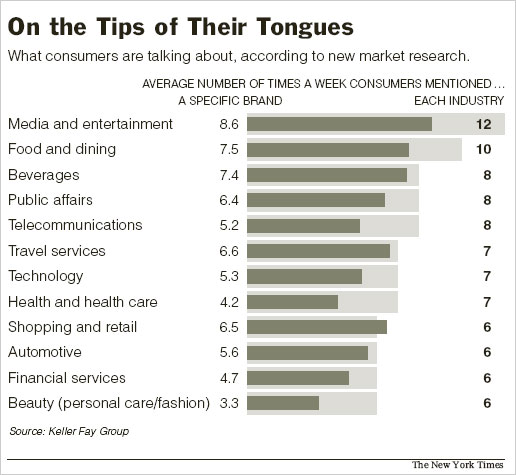


According to the study, influencers or "conversation catalysts" comprise 15% of the population, but account for more than one-third of brand-related word-of-mouth. The research, based on interviews with 7,200 Americans ages 13-69, found that these influencers referenced brand names in at least 184 conversations each week, compared to 114 for non-influencers.

The above chart illustrates the average number of times per week that these influencers mentioned a specific brand and industry. The industry mentions shows the context of conversations while the brand mentions illustrates those brands who have succeeded in achieving the strongest possible WOM status, i.e. mentioned in the conversations of the influencers to those they influence.

The study also found that certain brands are more likely to be named than others - Pepsi, Coke, Target, Honda, Sony and Apple generated the highest volume of word-of-mouth conversations among all the brands discussed.

For brands, it is these influencers, or influentials, who represent the powerful "some' that brands need to engage through its marketing efforts. Yada, yada, yada.

Thursday, November 5, 2009

Getting Out The Votes (Dollars) For Your Brand

How Marketers Can Learn From Politics


Marketers can learn a lot from their political campaign colleagues i.e. knowing one's constituencies, packaging the candidate, getting out the vote, and employing effective media to name a few.

The political campaign objective? Get your candidate more votes than the others on the ballot. The marketing campaign objective? Get more dollars than the others in the register.

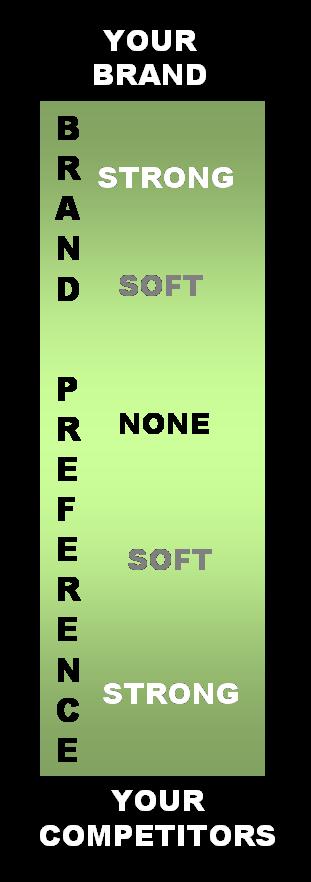
Smart political campaign managers know the landscape. They know that the voters can be looked at as a spectrum from "strongly for" to "softly for" to "undecideds" to "softy against" to "strongly against". Where, therefore, should they wisely invest their limited resources? Logically it would be to convert the "softly for" to the "strongly for" and the "undecideds" to the "softly for". Next, albeit, a tougher task, to convert the "softly against" to "undecideds" and then have a shot at luring them to the "softly for". This is based on the premise that it is highly improbable to poach votes from another candidate's "strongly for" base.

The same can be said in today's consumer democracy where consumers vote with their dollars. When developing a marketing plan with limited resources, it is important to first define and understand the brand preference spectrum. One is more likely to have a better R.O.M.I. (return on marketing investment) with those consumers with a strong and soft preference for the brand. Next target - those consumers with no brand preference, followed by those who have a soft preference for competitors. The likely success of trying to convert consumers with a strong preference for your competitors is highly doubtful. It is also true that the stronger the consumer preference for your brand, the less marketing investment is required to retain their repeat business. Conversely, the stronger the preference for your competitor, the greater the marketing investment required for the benefit derived.

Know your brand preference spectrum, invest accordingly, and get out the vote for your brand.

Saturday, August 30, 2008

"Where's Waldo?" - Cutting Through The Clutter

Making Sure Your Brand Stands Out From The Crowd

By David Miranda


We've all been exposed to Martin Handford's famous franchise, "Where's Waldo?" where one views a picture of countless characters in a crowded setting and the challenge is to find the stealthy bespectacled "Waldo". Depending on your visual acuity and search technique, you eventually find him. Of course, from that point of discovery thereafter, every time you view the picture, you immediately find him.

Every day consumers and brands play "Where's Waldo?" for real in the marketplace and the stakes are serious - brand recognition, sales, and market share, i.e. before someone buys your product or service they have to know about it - and find it! Sounds simple, but in a crowded and cluttered marketplace there are many "Waldos" and this is why marketing is critical.

A company cannot simply introduce a brand in a crowded landscape. It must develop a compelling and recognizable brand (Waldo); position the brand to distinguish it from the other "Waldos"; and communicate and reinforce with consumers where to find (purchase) the brand's offerings. This is a relentless pursuit since the landscape continues to change and more Waldos are putting themselves in the picture every day.

Make your Waldo obvious to consumers every day with smart marketing.


Friday, July 18, 2008

Name Everyone You've Ever Met

Chances Are The List Is Small

By David Miranda

Our memory is generally good - but that not good. That's why we rely on Outlook, Rolodexes,photo albums, diaries, reunions, weddings, funerals, home movies, and various other tools, devices, and methods to help us remember and remind us of people we know.

From this group of everyone we've ever met or known, we all have a much shorter list that we can extemporaneously share. These are people, whether they we friends, family, or business colleagues that we have the most recent, frequent, or strongest ties with. Others, for one reason or another, have drifted away from your brain's short list - until, however, you are reminded by that unexpected phone call or email; spring cleaning of your Outlook or Rolodex, or attending that reunion, wedding, or funeral.

Such is the case with brands. Name every brand you've ever purchased. Chances are you will remember a short list, but have forgotten more than you've remembered. This is why brands need to advertise - to keep their brand top of mind with people with short memories. The brands that occupy top of "unaided brand recall" lists have a significant advantage over those that do not.

There are a gazillion brands out there, but only a few you will be able to recall without some help. Take this simple test and see how you:

Name three brands in each of the following categories:

  1. bottled water
  2. luggage
  3. shoes
  4. mobile phones
  5. shampoo
  6. SUV's
  7. batteries
  8. snack foods
  9. fast food chain
  10. online shopping sites

Considering the many to choose from, think why you made your choices.

It's probably because these brands advertised to you. Just like in personal relationships, unless one or both parties make and effort to engage, i.e. "stay in touch", they won't make the cut for your short list.

The lesson is this. Forget about your audience and you are relegated to dusty memory files in the back of people's minds. Keep your brand current or go the way of such once dominant brands as Pepsodent, RC Cola, Netscape, RCA, Atari, Motown, Timex, PF Flyers, TWA, Braniff, PanAm, etc.

Today preference is perishable in a world of uber-choice.

Saturday, January 20, 2007

Marketers Are The Investment Bankers Of Brands

Is Your Brand Gaining Or Decreasing In Value?


You have no doubt heard the term, R.O.M.I (Return On Marketing Investment). It is the critical metric on the success of a brand's marketing investment. Just like an investment banker's success is measured on the increased value of investment portfolios, a marketer is responsible for increasing brand value for the company. The CMO of a company is really a CMIO (Chief Marketing Investment Officer).

For the past six years, for example, BusinessWeek and global brand consultancy, Interbrand have produced its annual rankings on the most valuable brands in the world. The report identifies the top 100 global brands that have managed to create and sustain strong performance in today’s competitive market. (The Top Ten Global Brands are shown in the chart above) Brand values were determined using the method Interbrand pioneered nearly 20 years ago and has since used to value more than 4,000 brands. Brand value is calculated as the net present value of the earnings the brand is expected to generate and secure in the future for the time frame from July 1, 2005 to June 30, 2006.

BusinessWeek 2006 Best Global Brands Highlights

Turnaround Performances: After year over year decline from 2000 to 2004, Nokia (#6) has regained its leadership position in the mobile telecom industry with growth in both the high and low ends of the market. Nokia’s scale has always made it competitive in the rapidly growing low priced segment, but a resurgence in design and a concentration on desirable features has meant that Nokia is now able to maintain its average selling price and reinvigorate its brand image with the high end consumer. Likewise, Motorola (#69) has historically struggled in the high end of the market…until the Razr. A hero product, it has in recent years helped the brand maintain its solid number two position in the category.

Top Gainers: The top gainer with a brand value increase of 46%, Google (#24) creates growth under with the strategy of "do no evil" positioning itself at the opposite end of the spectrum from the more corporate Microsoft. Overall growth of Internet commerce has perpetuated consumers’ acceptance of purchasing goods and services online enabling eBay (#47) to skyrocket in value up 18% and the third highest gainer this year. In the second spot with a value increase of 20%, Starbucks (#91) has found financial success by leveraging the brand with a premium fast food and extending its product offering into music and publishing.

Top Decliners: The growth of mass retailers has taken market share from traditional apparel brands such as Gap (#52). Losing the most brand value with a decline of -22%, Gap has been unable to clarify its brand image and with a less distinct positioning the brand has been less effective at selling clothing causing reduced long-term stability. Ford (#30) continues to lose money on every car sold – and brand value year after year. Down -16% this year, Ford’s American heritage is an insufficient brand attribute to hold off growing competition from Japanese and German automakers. Down -12% this year, Kodak (#70) has made valiant strides to catch up with the digital world, however the reality is that competition is fierce and profitability is thin compared to Kodak’s film business and thus the brand’s value continues to decline.

In summary, it is important to understand that every marketing decision for a brand is an investment decision. Invest wisely.

Thursday, November 30, 2006

Recognizing Smart Brands Can Do Dumb Things

Always Remember The Customer Knows Best


Back in the 1980's, the world's most valuable and recognizable brand, Coca-Cola decided that their core product needed a new formula. In the years leading up to this decision, Coke had been victimized by The Pepsi Challenge where Coke customers participated in blind taste test across the country preferring Pepsi to Coke.

Coke decided to do their own research testing a new formula with Coke drinkers and discovering that more preferred the new taste than the old.

The decision was made. The introduction of New Coke to considerable media fanfare as the Chairman and CEO of The Coca-Cola Company, Roberto Gouizeuta announced the new formula.

The result was one of the biggest marketing blunders in history. Almost immediately, loyal Coke drinkers rebelled with protests and boycotts that filled the consumer and trade media. Their message? What have you done? We want our old Coke back.

Of course, Pepsi was delighted. It's eventual Chairman and CEO, Roger Enrico later wrote a book entitled, "The Other Guy Blinked: How Pepsi Won The Cola Wars".

But what happened? Coke had some of the brightest marketing people in the world. It's SVP of Marketing, Sergio Zyman, an architect of New Coke, was recruited from Pepsi. How could smart people make such a dumb decision?

The answer, in hindsight, is that no one asked the right question. The research they did was sound. When asked which they preferred in blind taste tests, they did, indeed, choose New Coke.

What was the question they didn't ask? They did not ask "Would you be willing to give up your existing Coke for New Coke? Had they asked this question, they would have received a resounding no. What Coke failed to take into consideration was the very thing that made Coke a great brand - brand loyalty. This misjudgement was fatal for New Coke.

Of course, there was a happy ending for Coke. They immediately pulled New Coke and launched Coca-Cola Classic.

There is a critical marketing lesson here and it's not that loyal patrons will resist change. It's you cannot get the right answers unless you ask the right questions.
Coca-Cola Classic is a trademark of The Coca-Cola Company. All rights reserved. 2006